- Why has system integration become essential?
- Why system integration has become a business necessity?
- ERP, CRM and PIM – the three pillars of a modern enterprise
- Integrating with an E-commerce Platform
- Enterprise Integration in Practice
- Common Mistakes in Enterprise System Integration
- Business Benefits of Integrating ERP, CRM and PIM
- When should you invest in custom integrations?
- Preparing your organisation for system integration
- Frequently asked questions
- Conclusion
Why has system integration become essential?
Digital transformation has led organisations to adopt multiple specialised business applications that support their day-to-day operations. Enterprise Resource Planning (ERP) systems manage core business processes and resources, Customer Relationship Management (CRM) platforms streamline sales and customer interactions, while Product Information Management (PIM) systems provide a central repository for product data.
Although each solution serves a distinct purpose, their true value is realised only when they operate as an integrated ecosystem. Seamless integration enables data to flow automatically between business functions, eliminating information silos and ensuring that every department works with accurate, up-to-date information.
In practice, most organisations expand their IT landscape gradually. An ERP system is often implemented first, followed by an e-commerce platform, a CRM solution, marketplace integrations, marketing automation tools, and additional specialised applications.
As a result, businesses frequently rely on multiple independent systems that are not designed to communicate with one another. Product information is duplicated, inventory data becomes inconsistent, customer records are fragmented, and employees spend valuable time manually transferring information between applications.
Today, the greatest challenge is no longer implementing additional software—it is integrating existing systems into a single, coherent technology ecosystem. A well-designed integration architecture eliminates data silos, reduces operational errors, and significantly improves business efficiency.
Why system integration has become a business necessity?
Only a few years ago, many organisations could successfully operate using a single enterprise application. Today, this approach is no longer sufficient.
The rapid growth of omnichannel commerce, marketplace sales, marketing automation, and increasing customer expectations has dramatically expanded the number of applications businesses depend on.
A modern IT ecosystem typically includes:
- Enterprise Resource Planning (ERP)
- Customer Relationship Management (CRM)
- E-commerce platform
- Product Information Management (PIM)
- Business Intelligence (BI) tools
- Warehouse Management System (WMS)
- Marketplace platforms
- Shipping and courier integrations
- Payment gateways
Each of these systems creates, processes, and stores valuable business data. Without automated synchronisation, organisations quickly encounter operational challenges, including:
- inconsistent product pricing across systems;
- outdated inventory information;
- duplicate data entry;
- inaccurate product descriptions;
- limited sales reporting capabilities;
- delays in order fulfilment;
- incomplete customer information.
System integration eliminates these issues by establishing a unified data flow across every application used within the organisation.
ERP, CRM and PIM – the three pillars of a modern enterprise
Although the terms ERP, CRM and PIM are widely recognised, their roles are often misunderstood. Each system addresses a different aspect of business operations, and together they create the technological foundation of a modern enterprise.
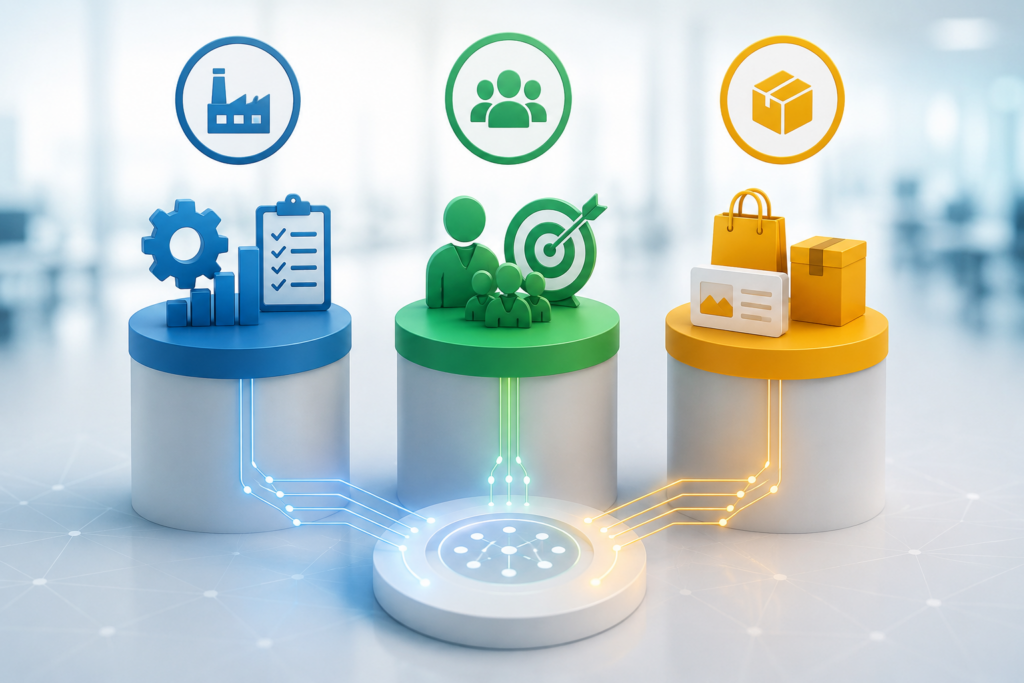
ERP – the operational core of the business
Enterprise Resource Planning (ERP) is the backbone of business operations. It centralises the management of financial processes, accounting, inventory, procurement, production, logistics, and numerous other mission-critical activities.
An ERP system is responsible for, among other things:
- warehouse management;
- inventory control;
- order processing;
- production planning;
- finance and accounting;
- settlements and invoicing;
- supplier management.
In many respects, an ERP system can be considered the “heart” of an organisation, as it stores and manages the operational data required to run the business efficiently.
Today’s market offers a wide variety of ERP solutions designed to meet different business requirements. Among the most widely adopted platforms are Microsoft Dynamics 365 Business Central, InsERT Subiekt GT, Subiekt nexo, and the Comarch ERP product family, including Comarch ERP Optima, Comarch ERP XL, and Comarch ERP Enterprise.
Selecting the right ERP solution depends on the organisation’s size, industry, and operational complexity. Regardless of the platform chosen, seamless integration with CRM, PIM, e-commerce platforms, and other business applications remains one of the most critical success factors.
CRM – A complete view of customer relationships
Customer Relationship Management (CRM) systems focus on sales processes and customer engagement throughout the entire customer lifecycle.
A CRM platform enables organisations to:
- manage customer contacts;
- track sales opportunities and pipelines;
- plan sales activities;
- maintain communication history;
- manage customer support requests;
- execute marketing campaigns;
- analyse sales performance.
When integrated with ERP, a CRM system allows sales representatives to instantly access customer order history, payment status, product availability, pricing agreements, and discounts – all without switching between multiple applications.
Popular CRM solutions include Microsoft Dynamics 365 Sales, Salesforce, HubSpot CRM, Pipedrive, Zoho CRM, and Livespace.
The optimal choice depends on the organisation’s size, sales model, and automation requirements. Regardless of the selected platform, the greatest business value comes from integrating CRM with ERP, e-commerce, and marketing automation systems, providing employees with a complete, real-time view of every customer interaction.
PIM – A single source of truth for Product Information
For organisations managing extensive product catalogues, a Product Information Management (PIM) system has become an essential component of the digital ecosystem.
Its primary purpose is to centralise and manage all product-related information from a single location.
A PIM system typically stores:
- product names;
- marketing descriptions;
- technical specifications;
- product images;
- user manuals;
- downloadable resources;
- multilingual translations;
- product attributes used by e-commerce platforms and marketplaces.
PIM becomes the authoritative source of product information for every sales channel.
In practice, this means that a product description is updated only once within the PIM system and is then automatically distributed to the online store, mobile applications, B2B portals, printed catalogues, and marketplace platforms.
This significantly reduces errors while accelerating the introduction of new products to market.
Among the leading PIM platforms are Akeneo PIM, Pimcore, Syndigo, inRiver PIM, and Contentserv. These solutions enable organisations to manage product descriptions, technical specifications, multimedia assets, translations, and marketing content within a single environment before automatically publishing them across all sales channels.
Integrating PIM with ERP and e-commerce platforms dramatically shortens product launch times while ensuring consistent product information across every customer touchpoint.
Integrating with an E-commerce Platform
Within a modern digital ecosystem, the e-commerce platform serves as the primary customer-facing sales channel. It consolidates information from multiple business systems while providing customers with a seamless purchasing experience.
A well-designed integration architecture ensures that the online store is not responsible for managing all business data independently. Instead, it retrieves information from the systems specifically designed to own and maintain it.
This approach guarantees data consistency, reduces administrative effort, and eliminates unnecessary duplication.
Data retrieved from the ERP System
The ERP system provides the operational data required to manage commercial transactions and order fulfilment, including:
- product pricing;
- inventory availability;
- sales documents and invoices;
- shipping information;
- order statuses.
Because these values are synchronised automatically, customers always see accurate product availability and current pricing, while operational teams work with reliable information across every sales channel.
Data retrieved from the PIM System
The Product Information Management (PIM) platform supplies all customer-facing product content, including:
- product descriptions;
- high-resolution images;
- videos and multimedia assets;
- technical specifications;
- multilingual content;
- marketing materials.
Maintaining all product information within a single repository ensures consistency across every touchpoint while dramatically reducing the effort required to introduce new products or update existing catalogues.
Data retrieved from the CRM System
The CRM platform enriches the customer experience by providing valuable commercial information such as:
- customer purchase history;
- customer segmentation;
- personalised pricing and discounts;
- individual commercial offers;
- sales representative activities and notes.
By integrating CRM with the online store, organisations can deliver personalised shopping experiences based on each customer’s profile, purchasing behaviour and commercial relationship.
The result is higher customer satisfaction, stronger loyalty and increased conversion rates.
Enterprise Integration in Practice
Every organisation develops a unique IT ecosystem based on its business model, operational processes and growth strategy.
In our own projects, we continuously enhance and expand our clients’ digital environments by implementing scalable integration architectures that support long-term business development.
One example is our long-standing collaboration with the Deni Cler brand, where we implemented a middleware-based integration platform connecting multiple enterprise systems.
The environment integrates:
- ERP;
- accounting software;
- logistics solutions;
- additional business applications supporting daily operations.
This architecture provides reliable communication between systems while simplifying future expansion as new technologies and business requirements emerge.
Common Mistakes in Enterprise System Integration
Many integration challenges do not arise from technological limitations but from poor architectural decisions made during the planning phase.
Understanding these risks early helps organisations avoid costly redesigns and implementation delays.
1. Lack of an Integration Strategy
Many organisations introduce new applications one by one without defining a long-term integration roadmap.
Initially, this approach appears cost-effective.
Over time, however, each additional application requires multiple custom integrations, creating unnecessary complexity and increasing maintenance costs.
A clearly defined integration architecture should always precede technology implementation.
2. Duplicate Data Across Multiple Systems
One of the most common integration problems is storing identical information in several independent applications.
For example, product information may exist simultaneously in:
- ERP;
- CRM;
- the e-commerce platform;
- spreadsheets maintained by individual departments.
When data is updated in only one location, inconsistencies quickly emerge.
Employees begin working with conflicting information, leading to operational inefficiencies and customer dissatisfaction.
Applying the Single Source of Truth (SSOT) principle eliminates this issue by assigning ownership of each data category to a single authoritative system.
3. File-Based Integration as the Primary Communication Method
Although importing and exporting CSV or XML files remains appropriate for certain business scenarios, relying exclusively on file-based integrations is no longer considered best practice.
Such processes typically involve:
- delayed data synchronisation;
- manual intervention;
- increased operational risk;
- limited scalability.
Modern organisations increasingly adopt API-driven integrations that enable continuous, real-time communication between applications.
4. Lack of Integration Monitoring
Even the most sophisticated integration architecture is vulnerable to unexpected issues.
Network outages, API changes, software updates or temporary service interruptions can all disrupt communication between systems.
For this reason, enterprise integration platforms should include comprehensive monitoring capabilities that can:
- detect communication failures automatically;
- identify failed transactions;
- notify administrators in real time;
- support rapid issue resolution;
- maintain complete audit trails.
Continuous monitoring significantly improves system reliability while reducing operational downtime.
5. Designing Only for Current Business Requirements
A common mistake is designing integrations solely around today’s operational needs.
Business environments evolve rapidly.
Organisations frequently introduce:
- additional marketplace channels;
- mobile applications;
- Business Intelligence platforms;
- Artificial Intelligence solutions;
- B2B commerce platforms;
- new international sales channels.
An integration architecture should therefore be designed with scalability in mind.
Building a flexible foundation today prevents expensive redevelopment projects tomorrow.
Well-designed enterprise integration is not a one-time IT initiative.
It is a long-term strategic investment that enables organisations to grow, adapt to market changes and continuously optimise business operations.
Business Benefits of Integrating ERP, CRM and PIM
In the previous sections, we explored the roles of ERP, CRM and PIM systems and examined how they can be connected through a modern integration architecture.
However, system integration should never be viewed as a purely technical initiative.
Its primary objective is to generate measurable business value by improving operational efficiency, reducing costs and enabling sustainable business growth.
A well-designed integration strategy delivers tangible benefits across every department of an organisation.
1. Eliminating manual processes
One of the most immediate advantages of system integration is the automation of repetitive tasks.
Instead of manually transferring information between applications, business data flows automatically throughout the organisation.
Typical examples include:
- automatic order processing;
- synchronisation of product information;
- inventory updates;
- price synchronisation;
- customer data exchange;
- document generation;
- shipment status updates.
By eliminating routine administrative work, employees can focus on activities that contribute greater strategic value to the business.
2. Consistent data across the organisation
Reliable decision-making depends on reliable information.
When multiple systems store different versions of the same data, inconsistencies quickly lead to operational problems.
Applying the Single Source of Truth (SSOT) principle ensures that every department accesses the same verified information.
As a result, organisations benefit from:
- consistent pricing across every sales channel;
- accurate inventory visibility;
- reliable customer information;
- uniform product content;
- improved reporting accuracy.
Consistent data also strengthens governance and simplifies regulatory compliance.
3. Faster order processing
Integration between ERP, CRM and e-commerce platforms enables end-to-end automation of the order fulfilment process.
Once an order is placed, information is transferred automatically between systems without requiring manual intervention.
This allows organisations to:
- process orders more quickly;
- reduce fulfilment errors;
- shorten delivery times;
- improve warehouse efficiency;
- increase operational capacity without proportional growth in administrative resources.
Automation directly contributes to improved productivity and lower operating costs.
4. Enhanced customer experience
Modern customers expect fast, accurate and consistent service across every interaction.
Integrated systems provide employees with immediate access to comprehensive customer information while ensuring that customers receive:
- accurate product availability;
- up-to-date pricing;
- rapid order confirmation;
- real-time shipment tracking;
- consistent communication across every channel.
This creates a smoother purchasing journey, increases customer satisfaction and strengthens long-term loyalty.
In today’s highly competitive markets, customer experience has become one of the most important differentiators.
5. Scalability and future growth
Business growth inevitably leads to greater technological complexity.
New sales channels, international expansion and additional business applications all increase the volume of data exchanged across the organisation.
A modern integration architecture enables companies to scale efficiently without redesigning their entire IT landscape.
Adding a new marketplace, mobile application or B2B portal becomes significantly simpler when existing systems are already connected through a flexible integration layer.
Scalability therefore becomes a strategic capability rather than a technical challenge.
When should you invest in custom integrations?
Not every organisation requires a sophisticated integration architecture from day one.
For smaller businesses operating only a few systems, standard integrations may be entirely sufficient.
However, there are clear indicators that suggest custom integration should be considered.
Typical situations include:
- more than three or four independent business applications;
- omnichannel sales operations;
- recurring data inconsistencies;
- manual processes limiting operational efficiency;
- international expansion plans;
- integration with multiple marketplace platforms;
- business processes not supported by standard SaaS connectors.
In these scenarios, implementing a dedicated integration layer—based on middleware or an API-first architecture – becomes a strategic investment that supports long-term digital transformation.
Preparing your organisation for system integration
Successful integration projects begin long before technical implementation.
They start with understanding business processes, defining responsibilities and establishing a clear data governance strategy.
Best practices include:
- analysing existing business processes;
- identifying all sources of business data;
- defining the master system for every data category (SSOT);
- designing the target integration architecture;
- selecting appropriate API and middleware technologies;
- validating end-to-end data flows;
- implementing monitoring and continuous optimisation after deployment.
The more thoroughly the planning phase is completed, the lower the implementation risk and the greater the long-term return on investment.
Frequently asked questions
Do ERP, CRM and PIM always need to be integrated?
Not necessarily.
However, for organisations operating multiple business systems, integration has become the industry standard because it eliminates manual processes, improves data quality and increases operational efficiency.
Is system integration expensive?
Implementation costs vary depending on the complexity of the existing IT landscape.
Although integration requires an initial investment, organisations typically achieve significant long-term savings through process automation, reduced operational errors and improved productivity.
Can systems be integrated without APIs?
Yes.
Legacy systems can still exchange information using alternative technologies such as file transfers or database synchronisation.
Nevertheless, API-based integration has become the preferred approach because it offers greater reliability, scalability and real-time communication.
How long does an integration project take?
Project duration depends on the number of applications involved, business process complexity and the required level of customisation.
Smaller projects may be completed within several weeks, while enterprise-scale integration initiatives often require several months.
Conclusion
Integrating ERP, CRM and PIM systems is no longer simply a technological enhancement- it has become a strategic business requirement.
Organisations that successfully connect their enterprise applications gain a significant competitive advantage through improved operational efficiency, greater data accuracy and enhanced customer experiences.
A modern integration architecture enables businesses to:
- eliminate repetitive manual tasks;
- establish consistent, reliable data across the organisation;
- accelerate order processing;
- improve customer satisfaction;
- support omnichannel commerce;
- simplify future expansion;
- create a scalable digital ecosystem capable of supporting long-term growth.
Ultimately, successful digital transformation is not determined by the number of enterprise systems an organisation deploys.
It depends on how effectively those systems communicate and operate together as one integrated environment.
A thoughtfully designed integration strategy provides the technological foundation that enables businesses to innovate, scale and remain competitive in an increasingly connected digital economy.
