- What is a custom software system?
- When does a custom software solution make sense?
- Benefits of custom software for businesses
- Disadvantages of custom software
- Custom software in the age of AI
- What can a custom software system do?
- Custom software as a long-term investment
- Mediaflex – your partner in custom software development
- Mediaflex's services
- Conclusion
Modern businesses operate in an environment where competitive advantage is increasingly driven not only by the quality of products or services but also by the efficiency of business processes. Many companies begin their operations using off-the-shelf software to manage sales, inventory, production, or customer relationships. However, as an organization grows, these generic solutions often stop meeting its actual business needs.
This is when an important question arises:
Is it worth investing in a custom software solution?
The answer is yes – but only if your company requires a system that supports its unique business processes rather than forcing employees to adapt their workflows to the limitations of standard software.
What is a custom software system?
A custom software system is an application designed and developed specifically for a particular business and its individual requirements. Unlike off-the-shelf software used by thousands of companies, a dedicated system is built based on:
- an analysis of business processes,
- the company’s objectives,
- its long-term growth strategy.
In practice, this means the software is tailored precisely to the organization’s needs. It can support a wide range of operations, including sales, logistics, manufacturing, document management, CRM, information flow, resource planning, and integration with other tools already used within the company.
The greatest advantage of this approach is that the software reflects the way the business actually operates instead of requiring the business to change its processes to fit the limitations of a generic solution.
When does a custom software solution make sense?
Not every organization needs software built from scratch. In many cases, standard ERP or CRM systems perform their role perfectly well. The challenge arises when a company develops unique processes or operates in an industry that requires highly specialized solutions.
A custom software solution is particularly worth considering when a company:
- has unique or highly specialized business processes,
- relies on multiple independent systems that need to be integrated,
- wants to automate repetitive tasks,
- is developing its own digital product,
- requires a high level of data security,
- needs software that can evolve alongside the organization.
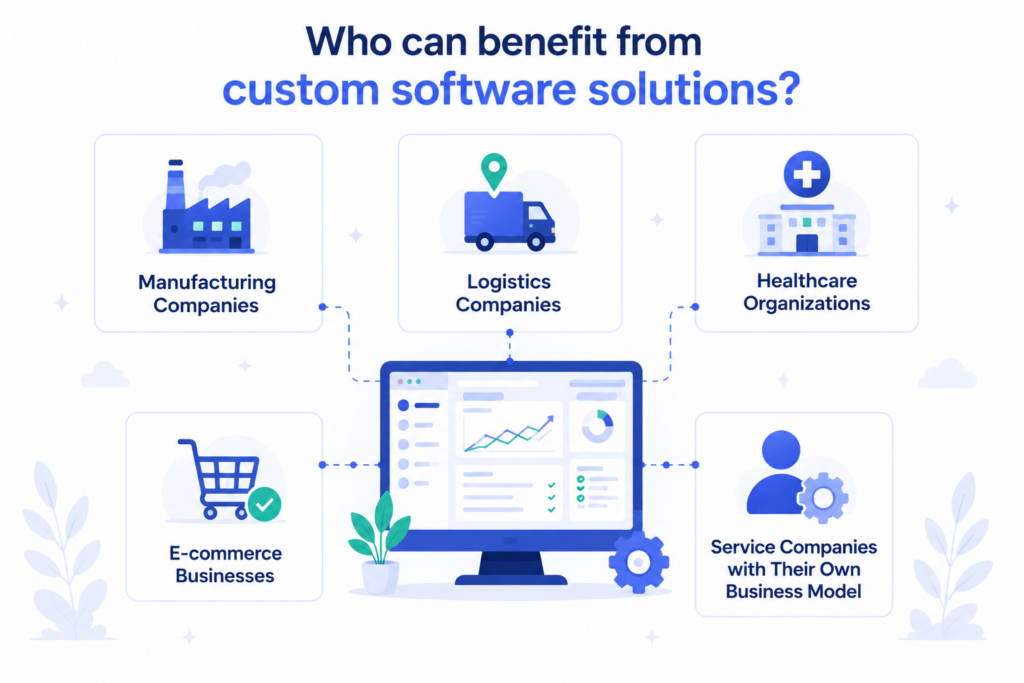
Typical examples include manufacturing companies, logistics providers, healthcare organizations, e-commerce businesses, and service companies with proprietary operating models. In these cases, standard software often creates more challenges than benefits.
Benefits of custom software for businesses
Perfect fit for business processes
The greatest advantage of custom software is that its functionality is fully aligned with the way the business operates. Every module is designed with specific users and real business requirements in mind.
As a result, employees no longer need to find workarounds or perform unnecessary additional tasks caused by the limitations of off-the-shelf software.
Unlimited scalability
Businesses evolve over time. They introduce new products, modify organizational structures, and optimize their processes. A custom software solution can grow alongside the company.
Adding new modules, features, or integrations does not require replacing the entire system. This allows the investment to retain its value for many years.
Process automation
Modern custom software significantly reduces the number of manual operations performed by employees.
Features such as automatic document generation, notifications, data synchronization, workflow automation, and integrations with ERP, CRM, warehouse management, or accounting systems help save time while minimizing the risk of human error.
Integration with existing business tools
Most companies use multiple applications across different departments. A custom software solution can be seamlessly integrated with:
- ERP systems,
- CRM platforms,
- e-commerce platforms,
- payment gateways,
- courier services,
- warehouse management systems,
- manufacturing systems,
- mobile applications,
- business intelligence and analytics tools.
This creates a single, unified ecosystem instead of several disconnected applications.
Enhanced security
Custom-built software enables organizations to implement security mechanisms tailored to their specific operational requirements.
These may include:
- role-based access control,
- data encryption,
- user activity logging,
- automated backups,
- GDPR compliance,
- Single Sign-On (SSO) integration.
Disadvantages of custom software
Although the benefits of custom software are substantial, it is equally important to consider its potential limitations.
Higher initial investment
Developing a custom software solution involves several stages, including business analysis, system architecture design, UX/UI design, software development, testing, and deployment.
As a result, the initial investment is typically higher than purchasing licenses for an off-the-shelf solution.
However, when viewed over the long term, the total cost of ownership is often lower. Companies avoid paying for unnecessary features, additional user licenses, expensive customizations, or inefficient workarounds that are commonly associated with generic software.
Longer development time
Custom software cannot be built in just a few days. The development process includes requirements analysis, solution design, programming, testing, and implementation.
Depending on the project’s complexity, delivery may take anywhere from several weeks to several months.
Choosing the right technology partner
The success of a custom software project depends largely on the experience of the software development partner.
Technical expertise alone is not enough. A reliable software house should also understand the client’s business processes and be able to recommend solutions that deliver measurable business value rather than simply writing code.
Custom software in the age of AI
Today, custom software does much more than organize business processes – it increasingly automates and enhances them through Artificial Intelligence (AI).
In 2024, nearly half of all newly developed custom software projects incorporated AI or Machine Learning (ML) components for predictive analytics, intelligent automation, or decision support.
Real-world implementations clearly demonstrate the impact of these technologies:
- AI-powered customer service agents have reduced average response times from 11 minutes to less than 2 minutes.
- In complex business environments, AI agent-based systems have shortened process execution times by 30–50%, delivering improvements approximately three times greater than traditional rule-based automation.
However, AI should not be viewed as a standalone solution.
Meaningful business value is achieved only when AI is combined with well-designed processes and implemented strategically within the organization. This is where an experienced technology partner becomes essential – one that can integrate AI into real business workflows rather than simply adding AI features for the sake of innovation.
What can a custom software system do?
A well-designed custom software solution becomes the operational hub of an organization.
It can support a wide range of business functions, including:
- Sales management
- Customer service
- Customer Relationship Management (CRM)
- Production planning
- Logistics management
- Warehouse management
- Electronic document management
- E-commerce platforms
- Reporting and Business Intelligence (BI)
- Mobile applications
- Workforce management
- Task scheduling
- Marketing automation
In practice, all these capabilities can operate within a single integrated platform.
This means that information entered into one module becomes immediately available across the entire system, eliminating duplicate data entry, reducing errors, and significantly improving operational efficiency throughout the organization.
Custom software as a long-term investment
Although developing a custom software solution may initially appear expensive, it should be viewed as a strategic investment in the company’s future.
Automating business processes shortens task completion times, reduces human error, improves employee productivity, and enables more effective data management. In addition, organizations remain independent of third-party software vendors and their licensing policies.
Over the long term, a custom software solution can become a significant competitive advantage, supporting sustainable business growth while reducing operational costs.
Mediaflex – your partner in custom software development
One example of a company specializing in custom software development is Mediaflex, a software house that has been delivering digital solutions since 2008.
The company develops projects for both B2B and B2C clients, focusing on software tailored to each client’s unique business processes and operational requirements.
Among the custom systems continuously developed and maintained by Mediaflex are:
Pharma Pass
A centralized authentication platform that enables healthcare professionals to register and securely access all of the client’s online services through a single system.
Conference Support System
A comprehensive platform for managing conferences and events, supporting organizers throughout the entire event lifecycle – from registration and communication to administration and reporting.
SimOne
A sophisticated web platform accompanied by mobile applications designed to support employee development by providing educational resources, knowledge management tools, and professional training.
Mediaflex’s services
Mediaflex specializes primarily in the design and development of custom software solutions, web applications, and business platforms built to meet individual client requirements.
The company’s expertise also includes:
- native and cross-platform mobile applications for iOS and Android,
- Magento 2 e-commerce solutions,
- modern corporate websites,
- UX/UI design,
- business analysis,
- user experience research,
- digital product design.
An important part of Mediaflex’s offering is the integration of business systems, including ERP and CRM platforms, payment gateways, and other enterprise applications.
These integrations create a unified digital ecosystem that streamlines information flow across departments and improves overall operational efficiency.
Mediaflex delivers end-to-end software development services – from business analysis and Product Discovery workshops, through UX/UI design and software development, to testing, deployment, and ongoing maintenance under Service Level Agreement (SLA) support.
The company follows an iterative development approach, allowing software solutions to evolve continuously alongside changing business needs.
Conclusion
Custom software is not the right solution for every organization. However, for businesses with complex operations or unique business processes, it is often one of the most effective investments in long-term growth.
A fully tailored solution, seamless integration with existing systems, extensive automation capabilities, and virtually unlimited scalability enable organizations to increase efficiency while reducing operational costs.
Ultimately, the success of a custom software project depends on selecting the right technology partner – one that not only develops software but also understands the company’s strategic objectives and business challenges.
Mediaflex follows precisely this approach, delivering comprehensive custom software projects from initial business analysis and solution design to implementation, continuous development, and long-term support.
As a result, clients receive more than just software – they gain a scalable digital platform that supports their business today while remaining ready for tomorrow’s challenges.
