- What is E-commerce system architecture?
- Why is e-commerce architecture so important?
- What does a modern e-commerce ecosystem consist of?
- What should the data flow in e-commerce look like?
- Monolithic architecture – simplicity vs. limitations
- Modular architecture – A balance between simplicity and flexibility
- Microservices in E-commerce – Do they always make sense?
- Headless Commerce – separating the frontend from the backend
- E-commerce performance starts with architecture
- E-commerce architecture and SEO
- Security as part of the architecture
- How to design an e-commerce system architecture?
- The most common e-commerce architecture mistakes
- SaaS, Magento 2 or a dedicated system?
- How to choose the right e-commerce architecture?
- E-commerce architecture and business scalability
- Is an e-commerce architecture audit worth it?
- E-commerce system architecture as an investment in the future
- Summary
- FAQ – E-commerce systems architecture
- What is e-commerce system architecture?
- What components does an e-commerce system consist of?
- How do you design an online store architecture?
- Does every online store need headless architecture?
- Why is API important in e-commerce?
- How does architecture affect store performance?
- When is it worth choosing Magento 2?
- When is it worth creating a dedicated e-commerce system?
- What are the most common e-commerce architecture mistakes?
- Can the architecture of an existing online store be rebuilt?
- What should an e-commerce architecture audit include?
Modern e-commerce is much more than an online store. Behind the website customers see, there is an extensive technology ecosystem responsible for product management, pricing, inventory levels, orders, payments, logistics, customer service, marketing, and analytics.
As a company grows, the number of systems that need to work together also increases. An e-commerce platform communicates with ERP, CRM, PIM, WMS, payment systems, courier companies, marketplaces, and marketing automation tools. Each of these elements serves a different purpose, but they should all form a consistent ecosystem.
This is why e-commerce systems architecture is so important for the scalability, performance, and security of online sales.
A well-designed architecture allows a business to grow without having to rebuild the entire environment every time a new requirement emerges. A poorly designed one, on the other hand, becomes a barrier to growth: it can cause integration problems, slow down the implementation of changes, increase maintenance costs, and negatively affect the customer experience.
In this guide, we explain what e-commerce architecture is, what components it consists of, how to design data flows, and when it is worth choosing a SaaS solution, Magento 2, headless architecture, or a dedicated system.
What is E-commerce system architecture?
E-commerce system architecture defines how individual technology components are organized and the principles governing how they work together. In the simplest model, an online store consists of an e-commerce platform, a database, a payment system, integrations with suppliers, and an administration panel. For a larger organization, the situation is completely different.
The ecosystem typically includes:
- an e-commerce platform,
- ERP,
- CRM,
- PIM,
- WMS,
- CMS,
- payment systems,
- courier systems,
- marketplaces,
- marketing automation tools,
- analytics systems,
- a data warehouse,
- mobile applications,
- middleware or an integration platform,
- APIs,
- cloud infrastructure.
Therefore, e-commerce architecture should not be designed solely from a programming perspective. The starting point should be business processes. A company operating several warehouses, selling both B2B and B2C, offering individual pricing, advanced product configurators, and multiple sales channels will need a completely different architecture from a small store offering several hundred products.
The first question to answer should therefore be: How should the business operate?
Only then should the next question be addressed: Which systems and technologies will effectively support this business model?
Why is e-commerce architecture so important?
Architecture affects virtually every aspect of an online store’s operation. It determines, among other things:
- platform performance,
- the ability to handle increasing numbers of users,
- order processing,
- integration quality,
- data consistency,
- security,
- the ability to implement new features,
- maintenance costs,
- the ability to expand into new markets,
- the ability to launch new sales channels.

Architecture can therefore be described as the technological foundation of e-commerce. However, a good architectural design should not be oversized. The goal is not to create the most complex environment possible, but one that responds to the organization’s actual needs.
What does a modern e-commerce ecosystem consist of?
There is no single universal e-commerce architecture model. In practice, however, several key components can be identified.
E-commerce platform
The e-commerce platform is usually the central point of the entire ecosystem.
It is responsible, among other things, for:
- product presentation,
- catalog management,
- shopping cart,
- checkout,
- customer accounts,
- promotions,
- pricing,
- orders,
- payment processing,
- delivery integration.
Depending on the company’s needs, this may be a SaaS platform, Magento 2, another ready-made platform, or a dedicated system.
Magento 2 stands out, among other things, for its extensive customization capabilities and the ability to create custom modules. The official Adobe documentation describes the architecture of Adobe Commerce and Magento Open Source as a solution based on layers, modules, and extensibility mechanisms.
Mediaflex uses Magento 2 to deliver e-commerce projects requiring, among other things, advanced functionality and integrations with business systems. More information can be found in the article Magento 2 – The Foundation for Online Stores.
ERP – The center of operational processes
ERP, or Enterprise Resource Planning, is one of the most important systems in the entire business ecosystem.
Depending on the organization, it can be responsible for:
- inventory management,
- purchasing,
- sales,
- pricing,
- stock levels,
- documents,
- finance,
- suppliers,
- orders.
In e-commerce architecture, it is particularly important to determine which system is the source of truth for specific types of data.
Mediaflex discusses this model in more detail in the article ERP, CRM and PIM Integration – How to Organize Your Organization’s Ecosystem.
CRM, PIM, WMS and API
A modern e-commerce ecosystem does not end with the sales platform itself. Its important components include systems responsible for customer data, product information, warehouse operations, and efficient information exchange between individual solutions.
CRM (Customer Relationship Management) is responsible for collecting and using customer information. It allows businesses to track contact history, orders, and marketing activities, as well as better tailor communication and offers to customers’ needs.
PIM (Product Information Management) is used to centrally manage product information. Descriptions, specifications, images, variants, and technical data can all be stored in one place and then distributed across different sales channels. This ensures that product information remains consistent regardless of whether the customer uses an online store, mobile application, or marketplace.
WMS (Warehouse Management System) supports warehouse processes – from receiving goods, through their storage and picking, to preparing orders for shipment. Integrating WMS with e-commerce makes it possible to automatically transfer information about product availability and order fulfillment status, reducing the number of errors and manual operations.
The entire ecosystem is connected by API (Application Programming Interface), a mechanism that enables data exchange between different systems. Through APIs, an online store can communicate with CRM, PIM, WMS, ERP, payment systems, and external services. In a well-designed architecture, this enables automated information flows and makes it possible to develop additional ecosystem components without having to rebuild the entire platform.
In practice, CRM, PIM, WMS, and APIs form the backbone that enables e-commerce to operate more efficiently, scale sales, and provide a consistent customer experience across all channels.
What should the data flow in e-commerce look like?
One of the most important elements of architecture design is defining how data flows between systems.
An example sales process may look like this:
PIM → e-commerce → customer → order → ERP → WMS → shipment → customer
In practice, this means:
- PIM provides product information.
- The e-commerce platform presents the product.
- The customer places an order.
- The order is transferred to the system responsible for further processing.
- ERP updates the sales and inventory processes.
- WMS handles warehouse operations.
- The logistics system provides delivery information.
- The customer receives the order status.
This is supplemented by payments, invoicing, marketing communication, analytics, and after-sales service. That is why architecture should be designed not merely as a collection of applications, but as a map of processes and data flows.
Monolithic architecture – simplicity vs. limitations
One of the basic architectural models is the monolith.
In this approach, many functions are contained within a single application.
This can be beneficial when:
- the project is small,
- the number of features is limited,
- the team is small,
- business requirements are relatively simple.
Problems may arise as the system grows.
The larger the monolith, the greater the risk that changing one component will affect other functions. Deployments can become more difficult, while maintenance becomes increasingly expensive.
This does not mean, however, that a monolith is inherently a bad solution.
In many projects, a well-designed monolith will be a better choice than an unnecessarily complex microservices architecture.
Modular architecture – A balance between simplicity and flexibility
Modular architecture makes it possible to divide an application into logical components responsible for specific functions.
In Magento 2, modules are the basic unit for organizing functionality. Adobe emphasizes the importance of modularity and limiting dependencies between modules.
This approach makes it easier to:
- develop the system,
- test it,
- maintain it,
- deploy changes,
- isolate functionality.
Another important principle in Magento projects is avoiding direct code modifications. Adobe recommends extending the system using the mechanisms provided by the platform, as direct changes to the core code may be lost during updates.
Microservices in E-commerce – Do they always make sense?
Microservices involve dividing a system into independent services responsible for specific functional areas.
For example, separate services may be responsible for:
- product catalog,
- shopping cart,
- orders,
- payments,
- search,
- recommendations.
One advantage of this approach is the ability to scale and develop individual components independently.
At the same time, microservices introduce greater complexity.
This can result in challenges related to:
- communication between services,
- monitoring,
- observability,
- data consistency,
- error handling,
- deployments,
- security,
- infrastructure.
Therefore, the decision to use microservices should result from business and technical requirements rather than from the popularity of a particular architectural model.
Headless Commerce – separating the frontend from the backend
Headless commerce involves separating the presentation layer from the backend responsible for e-commerce processes. The frontend communicates with the backend through APIs. This is particularly interesting for organizations that sell through multiple channels:
- online store,
- mobile application,
- marketplace,
- self-service devices,
- omnichannel solutions.
The main benefit is the ability to develop the frontend independently. At the same time, headless architecture increases technological and organizational requirements. An additional communication layer is introduced, and the project requires an appropriate development infrastructure. Therefore, the question should not be:
“Should we use headless?” but rather: “What business problem will headless solve?”
If the answer is unclear, a traditional architecture may prove to be a better solution.
E-commerce performance starts with architecture
Online store performance is not solely a matter of server capacity. Speed is influenced by factors such as:
- application architecture,
- database communication,
- caching,
- CDN,
- query handling,
- integrations,
- the number of frontend scripts,
- data processing methods,
- queuing mechanisms,
- page generation methods.
Therefore, performance problems cannot always be solved by increasing hosting resources. If the architecture is inefficient, a more powerful server may only delay the emergence of the problem. In Magento 2, the way the frontend is designed is also important. One of the solutions used in Magento projects is Hyvä Theme, which simplifies the frontend layer and focuses, among other things, on performance and reducing unnecessary technological overhead. Mediaflex discusses this solution in more detail in the article Hyvä Theme in Magento 2 – A High-Performance Theme for an Online Store.
E-commerce architecture and SEO
SEO should be taken into account as early as the architecture design stage.
The system should support, among other things:
- a logical category structure,
- correct URLs,
- redirect management,
- canonical tags,
- indexing control,
- sitemap generation,
- structured data,
- multiple language versions,
- appropriate performance.
This is particularly important during store migrations. Changing platforms involves changes to:
- URLs,
- category structure,
- page generation methods,
- product attributes,
- indexing mechanisms.
Therefore, an e-commerce migration should be treated as both a technology and business project, rather than simply transferring data from one system to another.
Security as part of the architecture
Security should not be an add-on to an already completed system. It should be considered from the very beginning of the design process.
This includes:
- access control,
- authentication,
- API security,
- encryption,
- customer data protection,
- integration security,
- component updates,
- monitoring,
- event logging,
- backups,
- incident response procedures.
In its current Top 10:2025 ranking, OWASP identifies, among other issues, broken access control, security misconfiguration, software supply chain failures, cryptographic failures, injection, and insecure design.
In practice, this means that security should be considered at the level of the entire ecosystem, not just the online store itself. Integrations require particular attention. If the store communicates with ERP, CRM, PIM, payment systems, and external services through APIs, each of these connections represents a potential risk point.
How to design an e-commerce system architecture?
Architecture design should begin with several basic steps.
1. Business process analysis
First, map the processes:
product → publication → sale → payment → order → warehouse → delivery → customer service → analysis
Only then should appropriate systems be assigned to each stage.
2. Defining data ownership
For each type of data, identify the system that serves as the authoritative source.
For example:
PIM = product data
ERP = pricing and operational processes
WMS = warehouse operations
CRM = customer relationships
e-commerce = online sales and shopping experience
Of course, the exact division of responsibilities depends on the specific organization.
3. Designing data flows
It is necessary to determine:
- what data is transferred,
- between which systems,
- in which direction,
- how frequently,
- in what format,
- what happens in case of an error.
4. Defining performance requirements
It is worth analyzing:
- number of users,
- number of orders,
- catalog size,
- number of variants,
- number of concurrent users,
- seasonal traffic increases.
A store that normally handles 100 orders per day but needs to process several thousand during Black Friday should be designed with such scenarios in mind.
5. Planning for growth
Architecture should take into account not only today’s business.
If a company plans to:
- enter new markets,
- launch B2B sales,
- add marketplaces,
- introduce a mobile application,
- add more warehouses,
- implement a new ERP system,
these directions should be considered already at the design stage.
The most common e-commerce architecture mistakes
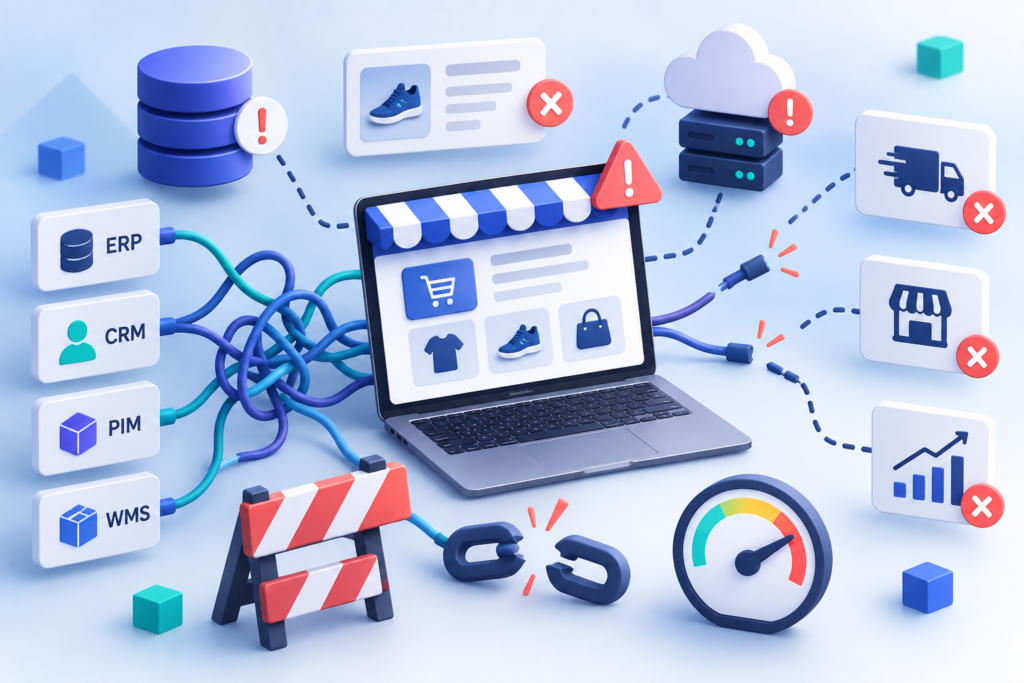
Trying to handle everything with a single system
A single system may be convenient at the beginning, but as a company grows, it can become a limitation. This does not mean that dozens of additional applications should be introduced immediately. The key is to distribute responsibilities sensibly.
No single source of truth
If the price of a product is stored in ERP, e-commerce, and additionally in an Excel spreadsheet, inconsistencies will quickly occur.
Too many direct integrations
The model:
ERP ↔ PIM ↔ CRM ↔ e-commerce ↔ WMS ↔ marketplace
can become very difficult to maintain if every system has multiple independent connections.
Lack of error handling
An integration can fail. An API can become unavailable. A system can return incorrect data. A connection can be interrupted.
A mature architecture should include, among other things:
- retry mechanisms,
- queues,
- logging,
- monitoring,
- alerts,
- data recovery mechanisms.
Designing only for the current scale
The store may perform well with its current number of products and orders, but the situation may look completely different a year from now.
Overcomplicating the architecture
Microservices, headless, event-driven architecture, and multiple additional layers do not automatically guarantee success. Every technology should solve a specific problem.
SaaS, Magento 2 or a dedicated system?
One of the most important decisions is how the e-commerce platform itself should be built.
SaaS
The SaaS model is a good solution for companies that need to launch sales quickly and want to limit their responsibility for infrastructure.
Its advantages include simplicity of implementation and maintenance.
However, its limitation may be reduced flexibility when dealing with highly customized processes.
Magento 2
Magento 2 is an interesting solution for organizations that need a high degree of flexibility, advanced features, integrations, and the ability to adapt the platform to their own processes.
Adobe provides detailed architecture documentation for Magento Open Source and Adobe Commerce, covering application layers, modules, the framework, APIs, and extension mechanisms.
Dedicated system
A dedicated system makes sense when a company’s processes are so specific that a ready-made platform would require too many compromises.
This may apply to:
- non-standard order processes,
- advanced configurators,
- specific pricing models,
- complex B2B sales,
- non-standard marketplace models,
- exceptionally complex integrations.
Mediaflex delivers both Magento 2 implementations and dedicated e-commerce systems, as well as projects involving sales process automation and business system integration.
How to choose the right e-commerce architecture?
It is better not to start with the question: “Magento or SaaS?”
Instead, begin by analyzing:
- Business model – Does the company sell B2C, B2B, or both?
- Scale – How many products, orders, and customers are currently being handled, and how many will there be in the future?
- Processes – Is the sales process standard, or does it require custom mechanisms?
- Integrations – Which systems does the store need to work with?
- Sales channels – Does the company operate only an online store, or also marketplaces, applications, and other channels?
- Growth – Which features are expected to be implemented over the next 2–3 years?
- Budget – This should not be limited to implementation costs. Maintenance, development, infrastructure, and future changes must also be considered.
E-commerce architecture and business scalability
A well-designed architecture should enable growth without requiring the entire system to be rebuilt.
Imagine a company that starts with a single online store.
After several years, it wants to:
- enter additional markets,
- launch B2B sales,
- add a marketplace,
- introduce a mobile application,
- connect several warehouses,
- implement a new CRM.
If each of these elements requires rebuilding the core platform, growth will be expensive and slow. If, however, the architecture was designed in a modular way, additional components can be developed gradually. This is one of the most important characteristics of a scalable e-commerce architecture.
Is an e-commerce architecture audit worth it?
If an online store is operational but problems are emerging that limit its development, it is worth analyzing the existing environment before deciding to completely replace the platform.
An e-commerce architecture audit may cover:
- application structure,
- code quality,
- integrations,
- data flows,
- performance,
- infrastructure,
- security,
- database,
- scalability,
- change deployment processes.
The result should not only be a description of problems, but above all a plan of action.
- Should the current system be optimized?
- Should the frontend be replaced?
- Should the integrations be reorganized?
- Should middleware be introduced?
- Should the platform be changed?
- Is a dedicated system required?
The answers should result from an analysis rather than from the assumption that every challenge requires rebuilding the store from scratch. If you are interested in a basic audit of your online store, contact us through our contact form.
E-commerce system architecture as an investment in the future
E-commerce is not a project that ends on the day the store goes live.
After implementation, another stage begins:
- feature development,
- optimization,
- monitoring,
- updates,
- security,
- integrations,
- new sales channels,
- changes to business processes.
Therefore, architecture should be prepared not only for today’s requirements.
It is worth asking:
Will we be able to easily add another sales channel next year?
Will it be possible to connect a new ERP system?
Will the system be able to handle increased traffic?
Will launching another country require rebuilding the entire application?
Can a new feature be added without risking the stability of other processes?
The answers reveal whether the current architecture is truly prepared for growth.
Summary
E-commerce systems architecture is the foundation of a smoothly operating online business. It is responsible not only for how the store functions, but also for communication between the e-commerce platform and ERP, CRM, PIM, WMS, payment systems, logistics, and other tools.
Good architecture should be:
- scalable,
- secure,
- high-performing,
- modular,
- easy to extend,
- resilient to integration failures,
- aligned with business processes.
This does not mean, however, that every e-commerce business needs microservices, headless commerce, or an extensive middleware layer.
The best architecture is not the most complex one. It is the one that best meets the needs of a specific business.
Therefore, designing an e-commerce system should begin with an analysis of processes, data, integrations, and growth plans. Only then should the technology and architectural model be selected.
Mediaflex delivers e-commerce projects including Magento 2 implementations, dedicated sales systems, integrations, and business process automation. The company emphasizes a comprehensive approach – from workshops and needs analysis, through design and implementation, to further development and maintenance of the solution.
If your current architecture is limiting the growth of your e-commerce business, it is worth starting with an analysis of the existing ecosystem. Sometimes the best solution will be to optimize the current platform. In other cases, it may be necessary to rebuild integrations, change the architecture, or implement a new solution.
Technology should be a tool for implementing business strategy, not an end in itself.
FAQ – E-commerce systems architecture
What is e-commerce system architecture?
E-commerce system architecture defines how an online sales platform is organized and how it works with other systems such as ERP, CRM, PIM, WMS, payment systems, and marketing tools. Its purpose is to ensure appropriate performance, security, scalability, and the ability to continue developing the system.
What components does an e-commerce system consist of?
An e-commerce system may include a sales platform, database, frontend, ERP, CRM, PIM and WMS systems, payment services, logistics, marketing tools, and an API integration layer. The scope of the architecture should be adapted to the business model and the company’s scale.
How do you design an online store architecture?
The process should begin with an analysis of business processes rather than technology selection. The next steps include defining data ownership, designing information flows and integrations, and taking performance, security, and future scalability requirements into account.
Does every online store need headless architecture?
No. Headless commerce makes the most sense for projects that require independent frontend and backend development and support multiple sales channels. In simpler projects, a traditional architecture can be easier and less expensive to maintain.
Why is API important in e-commerce?
An API enables communication between an online store and other applications. APIs can be used, among other things, to transfer product data from PIM, send orders to ERP, exchange inventory information, or transfer customer data to CRM.
How does architecture affect store performance?
Architecture affects data processing, database communication, caching, integrations, and the ability to scale infrastructure. Performance problems can therefore result not only from hosting but also from the way the entire system has been designed.
When is it worth choosing Magento 2?
Magento 2 can be a good solution for companies that need a high degree of flexibility, advanced integrations, custom processes, and the ability to further adapt the platform. The final decision should, however, result from an analysis of business needs.
When is it worth creating a dedicated e-commerce system?
A dedicated system makes sense when business processes are so specific that available platforms would require too many compromises or costly modifications. The decision should be preceded by an analysis of implementation, development, and maintenance costs.
What are the most common e-commerce architecture mistakes?
The most common problems include failing to define data ownership, having too many direct integrations, lacking error-handling mechanisms, designing exclusively for the current business scale, and unnecessarily complicating the architecture.
Can the architecture of an existing online store be rebuilt?
Yes. In many cases, modernization can be carried out in stages – for example, by reorganizing integrations, separating selected components, changing the frontend, optimizing performance, or introducing an integration layer. The scope of changes should result from an audit of the existing solution.
What should an e-commerce architecture audit include?
An audit should cover, among other things, application structure, integrations, data flows, performance, security, infrastructure, and further scalability. Its purpose is to identify the limitations of the existing solution and determine priorities for further development.
